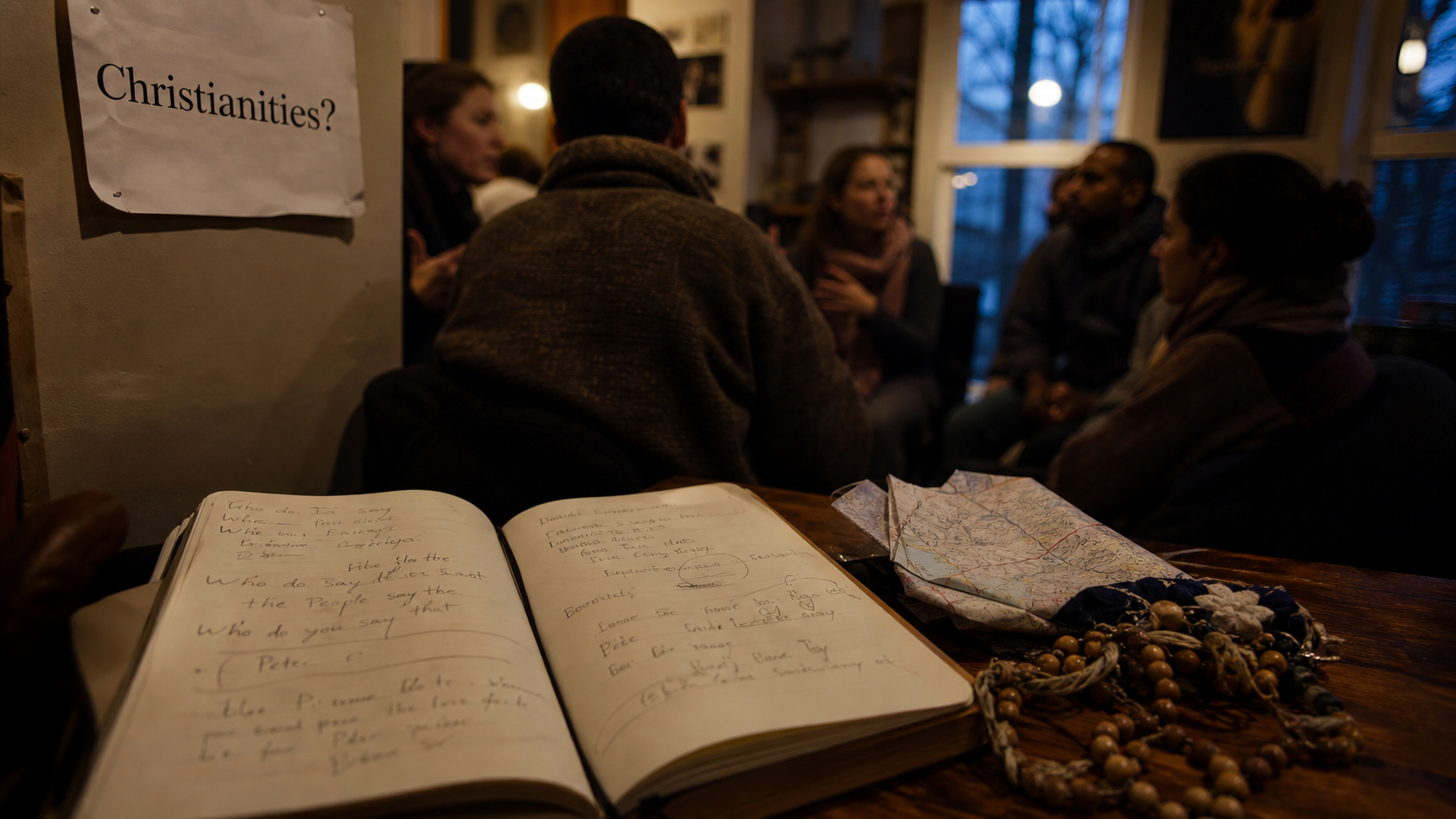
If you are searching for the Christianities? documentary, you are probably looking for the official project, the video featuring John Heers, or the Indiegogo page connected to Holy Wisdom Films. The film is presented as a question-led feature documentary about why Christianity can look so different across cultures, politics, traditions, and lived experience, while still claiming a shared center of faith.
Rather than treating Christianity as a neat category with one visible expression, the project asks a harder question: why do people across the world confess Jesus in different languages, inherit different customs, and often disagree about what Christian identity should look like? That tension is what gives Christianities? its title, including the question mark.
What the Christianities? documentary is really about
The documentary is described as a journey to the heart of the faith. Its premise is not simply that Christianity has many denominations, but that Christian life is shaped by history, culture, politics, belief, suffering, community, and memory. The plural form, Christianities, points to that diversity and keeps the question open instead of settling it too quickly.
The official framing also speaks to spiritual seekers and Christians who feel the weight of a chaotic world. The film asks where God is amid confusion and division, and why a faith centered on one figure can appear so fragmented in practice. It also explores whether Christianity today still has historical, intellectual, and spiritual continuity with its origins.
Why the question mark matters
The punctuation changes the tone. Without the question mark, Christianities could sound like a conclusion, many unrelated religions sharing a name. With the question mark, the documentary becomes an investigation. It asks whether the many visible forms of Christianity point to contradiction, adaptation, corruption, richness, or some mix of all of them.
This makes the film different from a basic explainer about denominations. It is less concerned with listing branches of Christianity and more focused on the deeper human and spiritual problem: what exactly is a Christian when language, culture, politics, and inherited practice pull the word in different directions?
John Heers and the people behind the project
The named host associated with the documentary is John Heers. He is presented not primarily as an academic or sociologist, but as a storyteller and student of history who approaches the subject through travel, conversation, curiosity, and humor. That matters because it shapes expectations: the film appears to be built around encounter and narrative rather than a lecture-style survey.
Heers’ background gives context to that approach. He studied history and education at Columbia University and earned a Masters Degree. His work has taken him through varied settings, including service in Mali, Africa, with the Peace Corps as a water resource manager, later work in the Georgian Republic, teaching in the South Bronx and Harlem, assisting in founding a school in Naples, Florida, and serving as a development director in Haiti.
First Things Foundation, Keipi, and lived cultural experience
John Heers is also connected with First Things Foundation, which is part of the biographical context around his work. The official material notes his creation of Keipi Restaurant in Greenville, South Carolina, a non-profit restaurant specializing in Georgian cuisine and culture. These details matter because the documentary’s subject is not abstract culture from a distance, but faith as it is carried by actual communities, hospitality, memory, and daily practice.
The Indiegogo result identifies the project as Christianities? Feature Documentary by Holy Wisdom Films. That makes Holy Wisdom Films one of the key names to recognize when checking that you are on a project page rather than a random commentary site or unrelated video.
The central questions the film sets out to explore
The documentary’s value lies in the questions it gathers together. Christianity is not treated only as a set of doctrines or institutions, but as a global reality lived through local languages, political wounds, family traditions, intellectual debates, and spiritual longings. The project says it will interview spiritual and intellectual leaders from around the world, which suggests an attempt to listen across boundaries rather than reduce the topic to one region or one church culture.
Why Christianity looks different around the world
One of the most practical questions behind the film is why Christianity in one place may look unfamiliar to Christians somewhere else. Worship, authority, symbols, social expectations, political alliances, and inherited customs can vary dramatically. The documentary frames politics, cultural beliefs, and other forces as part of the reason the faith appears divided.
The official presentation also uses multilingual renderings of the name Jesus to make this global scope visible. Names such as Yeshua, Gesù, Иисус, Chúa Giêsu, and others do more than decorate the project’s identity. They remind the viewer that Christianity has always moved through translation, and translation is never only linguistic. It also passes through architecture, music, kinship, law, food, persecution, empire, migration, and prayer.
What holds faith in place when everything shifts
A useful way to understand the film’s deeper question is through the image of an anchor. A ship can move with wind, tide, and current, yet an anchor gives it a point of resistance below the surface. In the same way, Christian communities may look different above the waterline, with different languages, feast days, political memories, styles of worship, or assumptions about community life. The documentary’s real tension is whether there is an anchor beneath those movements, a spiritual, historical, and intellectual continuity that keeps the faith from becoming merely a collection of cultural costumes.
That is why the film’s heart-and-mind appeal matters. It is not only asking what people feel when they say they are Christian. It is also asking whether those feelings connect to history, teaching, worship, and a recognizable spiritual inheritance. For viewers, this is the difference between seeing diversity as noise and seeing it as a map that may still have a center.
Where to watch, follow, or support the documentary
Because the search for this topic is often navigational, the safest approach is to look for the project’s official and project-related pages. The main destinations currently associated with the documentary are the official website, a YouTube result titled Christianities? With John Heers, and the Indiegogo campaign page for the feature documentary by Holy Wisdom Films.
| Resource | What it is useful for |
|---|---|
| Official website | Understanding the premise, host, project framing, and signing up for exclusive updates or behind-the-scenes content. |
| YouTube video | Watching the video presence connected to Christianities? With John Heers and getting a more immediate feel for the project’s tone. |
| Indiegogo project page | Checking the feature documentary campaign connected to Holy Wisdom Films and exploring any available support pathway. |
No release date, runtime, interviewee list, viewing platform, ratings, prices, or campaign financial details are visible in the material available on those pages. That does not mean those details are unavailable elsewhere. It simply means viewers should confirm current availability directly through the official website, YouTube page, or Indiegogo campaign before making assumptions.
What to check before supporting or sharing
If you are considering following or supporting the documentary, look for clear signs of project legitimacy: consistent naming, connection to John Heers, reference to Holy Wisdom Films where relevant, and links that point back to the official project ecosystem. For crowdfunding in particular, read the campaign page carefully, including any updates, estimated delivery information, contribution terms, and project status.
For viewers more interested in the spiritual and educational side, the official sign-up offer is the most direct path to exclusive updates and behind-the-scenes content. That may be especially useful if you want to know when the film becomes available, whether screenings are planned, or whether teaching, church, or discussion resources are later released.
Who the documentary is likely to resonate with
The film is likely to appeal to several overlapping audiences: Christians unsettled by division, spiritual seekers trying to understand God in a chaotic world, history-minded viewers, documentary fans, and people curious about how faith survives translation across cultures. It may also interest educators, pastors, or discussion groups looking for a more human entry point into questions of Christian identity.
Its strength is the combination of existential concern and global curiosity. The documentary does not appear to promise a quick answer to why Christianity is divided. Instead, it invites viewers into the question itself, whether the many forms of Christian experience can still reveal a coherent faith that speaks to both the heart and the mind.
That makes Christianities? less a simple religious documentary title than a provocation. It asks viewers to look at Christianity not only as an institution or label, but as a living tradition tested by place, power, language, suffering, memory, and hope.